

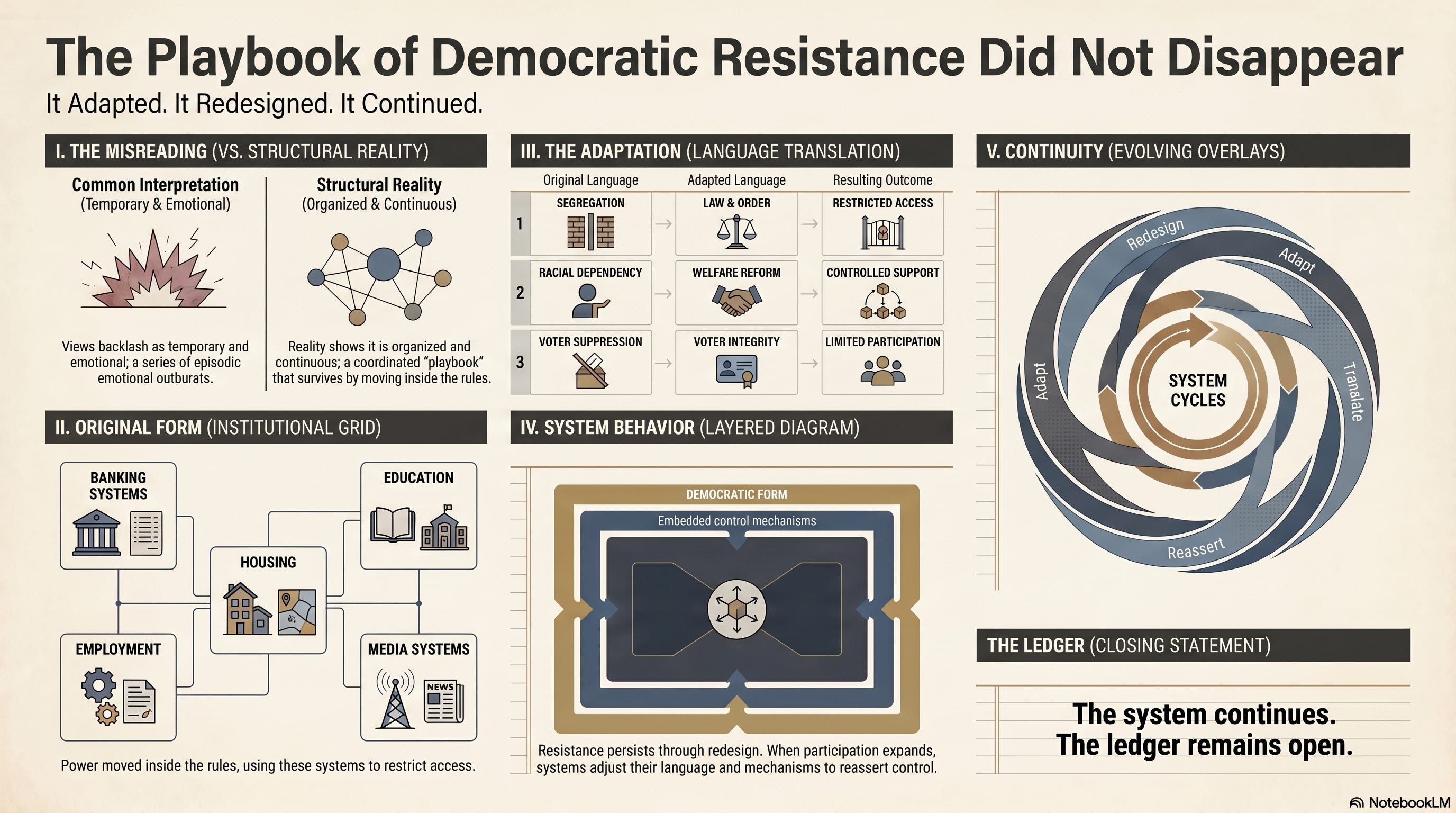
America narrates backlash as spontaneous; resistance to racial progress is framed as episodic, driven by fear or cultural anxiety, and destined to fade. That account is convenient. It is not true. What Black America has experienced is not episodic backlash but organized resistance: deliberate, coordinated, and continuously adapted.
The playbook did not disappear.
It adapted.
From the Citizens’ Councils of the 1950s to the MAGA movement of the present, the throughline is not emotion but design. Language changes. Delivery evolves. Presentation adjusts. The objective does not: preserve hierarchy while operating within the language of democracy.
This is not extremism at the margins. It is governance with a parallel logic.
Respectable Resistance
After Brown v. Board of Education, resistance did not erupt chaotically. It organized. White Citizens’ Councils formed across the South, led by bankers, lawyers, legislators, school board members, and publishers. They called themselves respectable.
Where the Ku Klux Klan relied on spectacle, the Councils relied on systems.
Their tools were administrative:
Mortgage cancellations
Loan denials
Employment termination
Credit blacklisting
Zoning pressure
School closures
Coordinated media framing
The force was not theatrical. It was procedural.
Overt violence drew federal attention. Procedure did not. So resistance moved inside the rules. It adopted the language of states’ rights, local control, and constitutional fidelity while restricting access in practice.
This was not a breakdown of democracy. It was a competing use of it.
The lesson was established early: opposition to equality could be executed without naming race.
The Language Evolves, the Aim Does Not
The movement traded its bullhorns for policy briefs. “Segregation forever” became “law and order”; “racial dependency” became “welfare reform”; “voter suppression” became “voter integrity.”
Each phrase functioned as translation: neutral language producing patterned outcomes.
The system did not require explicit statements. It required consistency of result.
Without historical context, the pattern appears as coincidence. With it, the continuity is visible.
By the late twentieth century, these approaches extended beyond the South. They entered think tanks, media ecosystems, suburban governance structures, and judicial reasoning. Regional origin became national application.
The accent did not travel. The architecture did.
MAGA Was Not an Anomaly
The MAGA movement did not originate these dynamics. It consolidated them.
Existing currents—economic grievance, racial hierarchy, cultural displacement, demographic anxiety—were aligned under a single frame and presented as patriotism.
What once required institutional coordination became publicly legible.
The mechanisms remained:
Erosion of confidence in elections
Delegitimization of courts and journalists
Framing multiracial participation as threat
Recasting inclusion as corruption
The distinction is not purpose. It is visibility.
The Inevitability of Resistance
Every expansion of American democracy has produced organized resistance:
Reconstruction
The New Deal
Civil Rights
Voting Rights
This pattern is not reactive. It is structural.
When participation broadens, control is contested. When power redistributes, systems adjust to contain it. The response is consistently framed as preservation rather than opposition.
Disorder is rarely the trigger. Rebalancing is.
Why Naming the System Matters
Misnaming the problem guarantees misdiagnosis. Treating democratic erosion as episodic or personality-driven obscures its mechanism.
The system does not resist democracy outright.
It resists outcomes that alter hierarchy.
Citizens’ Councils embedded exclusion within procedure.
MAGA renders it visible within rhetoric.
The method differs. The structure aligns.
Black America has not inferred this pattern. It has experienced it.
When access is restricted, systems are being tested.
When legitimacy is questioned, participation is being conditioned.
These are not isolated events. They are rehearsals.
Resistance to democracy in America does not recur; it persists through redesign.
The Decision Before the Country
At 250 years, the question is not whether resistance exists. It is whether it will continue to operate without acknowledgment.
Will democracy function as participation, or as managed perception?
The system has already answered in practice. The country has not answered in truth.
The playbook did not disappear.
It adapted.
And it continues to operate as designed.
The ledger remains open.