

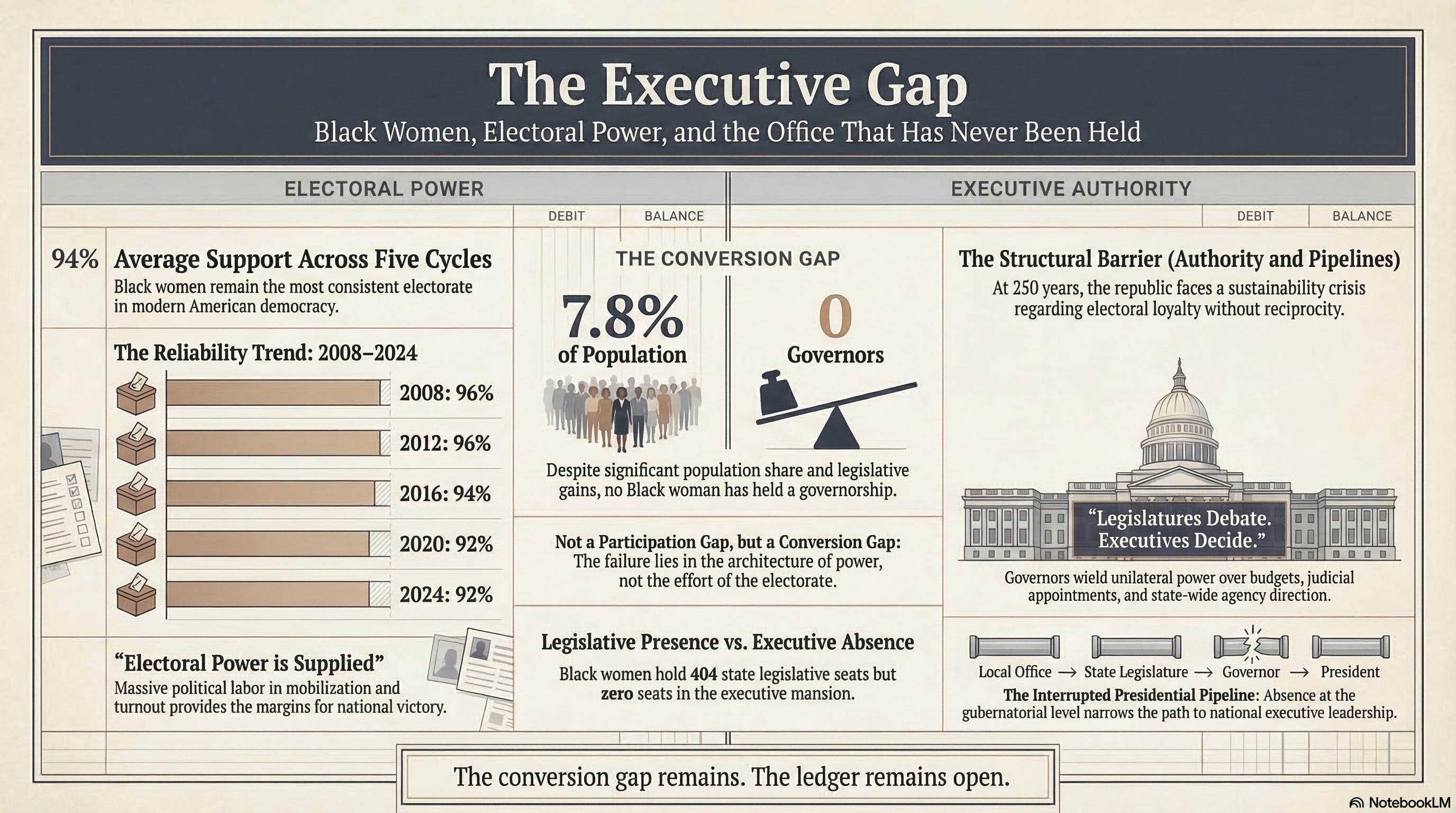
At 250, the most reliable electorate in American democracy has never occupied its highest executive seat.
I grew up in Ann Arbor, Michigan, where Albert H. Wheeler became the city’s first Black mayor after winning his election by a single vote.
His daughter, Alma Wheeler Smith, would later serve in both the Michigan House and Senate. At one point she considered a campaign for governor before stepping aside.
The lesson of that history stayed with me.
Municipal breakthroughs can occur.
Statewide executive conversion does not necessarily follow.
Black women are one of the most consistent voting blocs in modern American politics.
According to Higher Heights for America:
94 percent supported Hillary Clinton in 2016.
96 percent supported Barack Obama in 2008 and 2012.
92 percent supported Joe Biden and Kamala Harris in 2020.
92 percent supported Kamala Harris in 2024.
Election after election, Black women provide decisive margins.
Yet in the 250-year history of this republic:
No Black woman has ever been elected governor.
No Black woman has ever been elected president.
Higher Heights reports that Black women represent 7.8 percent of the U.S. population.
They hold 404 of the nation’s 7,386 state legislative seats.
Thirty-one serve in Congress.
For the first time in American history, two Black women now serve simultaneously in the United States Senate.
The gains are measurable.
The ceiling remains intact.
This is not a participation gap.
It is a conversion gap.
I. Electoral Capital Without Executive Return
American democracy depends on turnout.
It depends on persuasion.
It depends on reliable constituencies willing to organize, fundraise, mobilize, and defend institutions even when those institutions respond slowly.
Black women do all of it.
They organize church basements and suburban living rooms.
They canvas in heat and cold.
They defend voting rights, reproductive rights, public education, labor protections, health equity, and environmental justice.
They absorb backlash with a steadiness that rarely receives structural reward.
The pattern is visible.
Electoral power is supplied.
Executive authority is withheld.
This is not an accident of timing.
It is structural.
II. Representation Has Advanced. Executive Power Has Not.
The nation has witnessed historic breakthroughs.
The first Black woman Vice President.
The first Black woman Supreme Court Justice.
Expanded presence in Congress.
Increased statewide officeholders.
But executive office at the gubernatorial level remains untouched territory.
The governor’s office shapes budgets.
It appoints judges.
It signs or vetoes legislation.
It sets statewide regulatory agendas.
It negotiates federal dollars.
It determines a state’s posture toward education, healthcare, criminal justice, infrastructure, and civil rights.
Absence from that chamber is not symbolic.
It is structural.
Black women are decisive in electing governors.
They have never been one.
At 250, that asymmetry requires examination.
III. Ann Arbor and the Margin of One
The Ann Arbor history was not abstract to me.
I grew up there, where Albert H. Wheeler became the city’s first Black mayor after winning by a single vote.
His daughter, Alma Wheeler Smith, later served in both chambers of the Michigan legislature and briefly explored a run for governor before stepping aside.
Municipal breakthroughs proved possible.
Statewide executive conversion did not follow.
The margin of one vote demonstrated that political power can crystallize.
It also revealed how fragile conversion becomes when structures widen locally but resist expansion at the statewide tier.
The lesson is not about personality.
It is about architecture.
Municipal government absorbed the breakthrough.
The statewide structure did not.
That pattern repeats nationally.
IV. The Executive Gap as Structural Pattern
This is not simply about candidate pipelines.
It is about how authority consolidates at the executive tier.
Black women can mobilize turnout.
They can win legislative seats.
They can secure judicial appointments.
They can shape national elections.
But the governor’s mansion remains outside the arc.
The question at 250 is not whether Black women are qualified.
The question is why the most consistent electorate in the nation has not yet crossed the executive threshold at the state level.
The gap reveals something about American political inheritance.
Coalitions rely on Black women.
Structures hesitate to seat them.
V. The Arithmetic of Absence
Nearly eight percent of the population.
Zero governors.
That arithmetic is not anecdotal.
It is instructive.
In a federal system, governors build executive experience, national profiles, governing records, and donor networks that translate to higher office.
Absence at the gubernatorial level narrows the presidential pipeline before it begins.
When an electorate can decide elections but cannot enter the executive tier, the democratic structure tilts.
This is governance math.
VI. The Discipline of Political Labor
The discipline required to sustain turnout at the levels documented by Higher Heights is extraordinary.
It reflects civic literacy.
Strategic coordination.
Institutional memory.
Coalitional intelligence.
It reflects belief in the promise of democracy even when reciprocity remains incomplete.
Malcolm X once observed that the Black woman is among the most disrespected and neglected persons in America.
The durability of Black women’s political engagement in that context remains one of the republic’s least acknowledged stabilizing forces.
At 250, that force deserves structural consideration.
Not ceremonial praise.
VII. The Structure at 250
At 250 years:
Black women decide elections.
Black women serve in Congress.
Black women shape judicial doctrine.
Black women anchor civic mobilization.
No Black woman has been elected governor.
No Black woman has been elected president.
The creed of participation has advanced.
The architecture of executive authority has not kept pace.
Municipal breakthroughs proved possible.
Statewide executive conversion did not follow.
The gap is not about talent.
It is not about effort.
It is not about qualification.
It is about structure.
At 250, the republic must decide whether electoral loyalty without executive reciprocity is sustainable.
The ledger remains open.