

Previous issues of The Unpaid Ledger have addressed the structural challenges America faces at 250, including: a larger House of Representatives; full representation for D.C. and Puerto Rico; and a Supreme Court scaled to a 21st-century nation.
But democracy is not math alone.
Every American expansion has triggered American backlash.
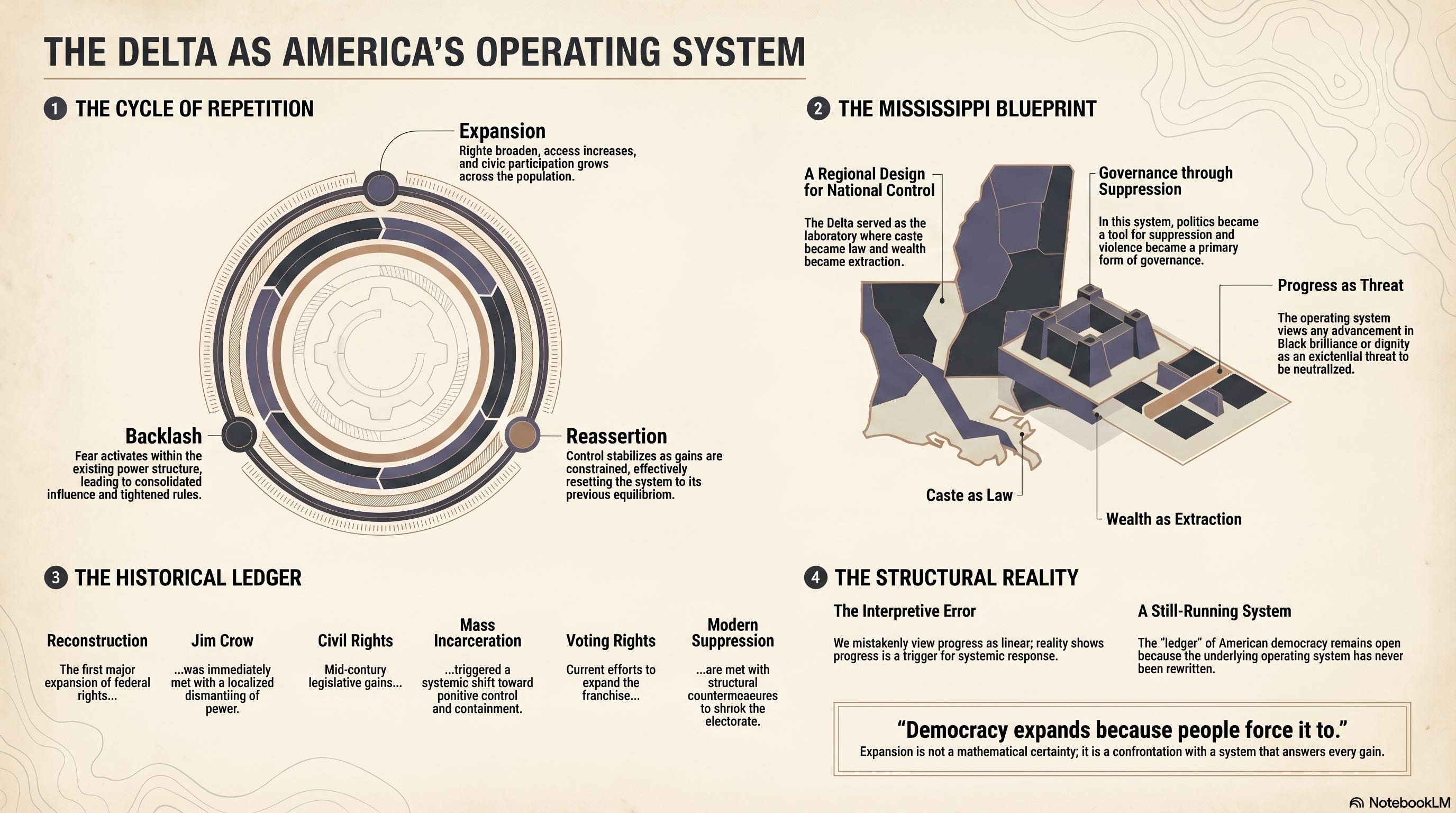
And that backlash was not invented in Washington; it was perfected in the Mississippi Delta: a place where soil, wealth, labor, violence, and political control fused into a strategic design the nation still imitates today.
Today, I urge you to stop romanticizing progress and confront the truth: democracy does not advance without a fight; and every gain invites a counterattack.
I. The Year I Realized I Was Reading for My Life
In 2025, I found myself asking a question millions of Black Americans were too exhausted to voice publicly: how could this country, with all its history, evidence, and consequence, consider the same path again?
I did not want sentiment. I wanted understanding.
So I read. And read. And kept reading.
Nearly 80 books in a single year: a cross-section of the nation’s moral X-ray:
• The Souls of Black Folk
• Before the Mayflower
• Incidents in the Life of a Slave Girl
• Stamped from the Beginning
• The Color of Compromise
• Tears We Cannot Stop
• Built From the Fire
• The Barn
• The Most Southern Place on Earth
• The Battle of the Black Mind
I have read nearly that number already in 2026.
The full list sits at revkttaylor.com/bookshelf: a map of my own awakening.
At first, I thought I was reading to understand America.
Then I realized I was reading to understand its patterns.
And every trail I followed; every book, every era, every wound; kept leading me back to the same place:
The Mississippi Delta.
Not as a metaphor, but as a blueprint.
II. The Delta Did Not Just Produce History; It Produced a System
The Delta is not simply a region.
It is the operating system beneath the Republic: the first place where
• caste became law;
• wealth became extraction;
• politics became suppression;
• violence became governance;
• and progress became threat.
Reading The Barn, I confronted why Emmett Till’s murder happened in the Delta, not elsewhere in Mississippi: because that was where white fear, white wealth, and white power were most tightly engineered; a place where Black brilliance was consistently met with white backlash.
Then The Most Southern Place on Earth forced me into the machinery:
• the richest soil in America;
• the wealthiest white planters;
• the most impoverished Black workers;
• the fiercest enforcement of racial order;
• the clearest demonstration that inequality is built, not natural.
The pattern sharpened:
Every time Black Americans expanded the possible, the Delta expanded the punishment.
This was not chaos.
It was design.
III. Tuskegee Reframed: The History Beneath the History
Then the reading turned me back toward Tuskegee University: the institution that shaped me.
As a University Escort, I told thousands of visitors the stories we were trained to recite:
• “Du Bois taught summer school in this very building.”
• “This hall was Washington’s vision made real.”
• “This campus is where Black genius built itself.”
But in 2025, reading The Battle of the Black Mind, something shifted.
Washington’s “Tuskegee Machine” appeared in three dimensions:
• part empowerment;
• part negotiation;
• part compromise;
• part survival strategy.
Du Bois’s critique landed differently: not as rivalry, but as diagnosis.
And Stamped from the Beginning demanded a more personal interrogation:
Was I as progressive as I assumed?
Or had I carried assimilationist instincts dressed up as antiracism?
The reading journey was not academic.
It was personal.
It rearranged my understanding of my alma mater; my country; and myself.
And all of it echoed one truth:
America does not fear Black decline.
It fears Black arrival.
IV. The Lineage That Made the Reading Unavoidable
I kept thinking about Holly Springs: my father’s birthplace; and Canton: my mother’s.
I kept thinking about the stories they told:
• an adolescent who could pick 400 pounds of cotton, four times his quota;
• ten people living in a house built for far fewer;
• baths taken in a #10 tin tub, one sibling after another, praying not to be last;
• a porch added by my father and uncles that created perhaps 200 square feet; and felt like an expansion of the world;
• the one-room schoolhouse where one misbehaving child meant a whole row was punished;
• the cistern that stored water because infrastructure never reached Black families.
I grew up on the stories of people who built more space when the house grew too small.
My father and uncles added 200 square feet to a crowded house just to breathe.
Today, we are attempting to fit a nation of 335 million into a legislative house built for 94 million.
This is not just a math problem.
It is structural overcrowding by design: a national reflection of the one-room schoolhouses and tin-tub baths of my parents’ Mississippi.
This is not abstraction.
It is the same structural overcrowding my parents survived in Mississippi; now imposed on a national scale.
V. Stop Being Pollyannish About Progress
Let us not lie to ourselves.
Expanding the House; granting statehood; and modernizing the Supreme Court are not administrative adjustments.
They are political battles that terrify the existing power structure.
These changes require:
• the legal genius of Fred Gray, Sr.;
• the oratorical brilliance of Barack Obama;
• the cultural magnetism of Oprah Winfrey;
• and the moral stamina of a people who have been reinventing this nation since the first ship landed at Point Comfort.
These reforms demand courage; coordination; and the willingness to risk political capital for something larger than survival: a functioning multiracial democracy.
Democracy does not expand because the math makes sense.
It expands because people fight for it.
VI. One Step Forward, Two Steps Back
Every expansion of rights has triggered a backlash designed to shrink them again.
Mississippi proves it:
• Rev. Hiram Rhodes Revels, the first Black U.S. Senator and A.M.E. minister, rose in 1870; and the state immediately began dismantling Black political power.
• Emmett Till was murdered and mutilated in the Delta; a warning to stop the rising tide of Black dignity.
• Medgar Evers was assassinated in his own driveway; a price exacted for demanding the basic rights of citizenship.
• And in 2026, Mississippi’s capital, Jackson, still suffers a water crisis that mirrors Flint: infrastructure as punishment.
And now, as the Supreme Court prepares to issue another decision that could further weaken the Voting Rights Act (Louisiana v. Callais), the pattern repeats.
VIII. Final Truth
The Delta is not a wound.
It is a warning.
It tells us this:
America does not lose its way by accident.
It retraces its steps.
The only question for the Semi-quincentennial is whether this nation will keep repeating the blueprint; or finally confront the place that taught it how to fear Black progress in the first place.
The Delta built the operating system.
We must now decide whether to rewrite it.
The ledger is still open.