

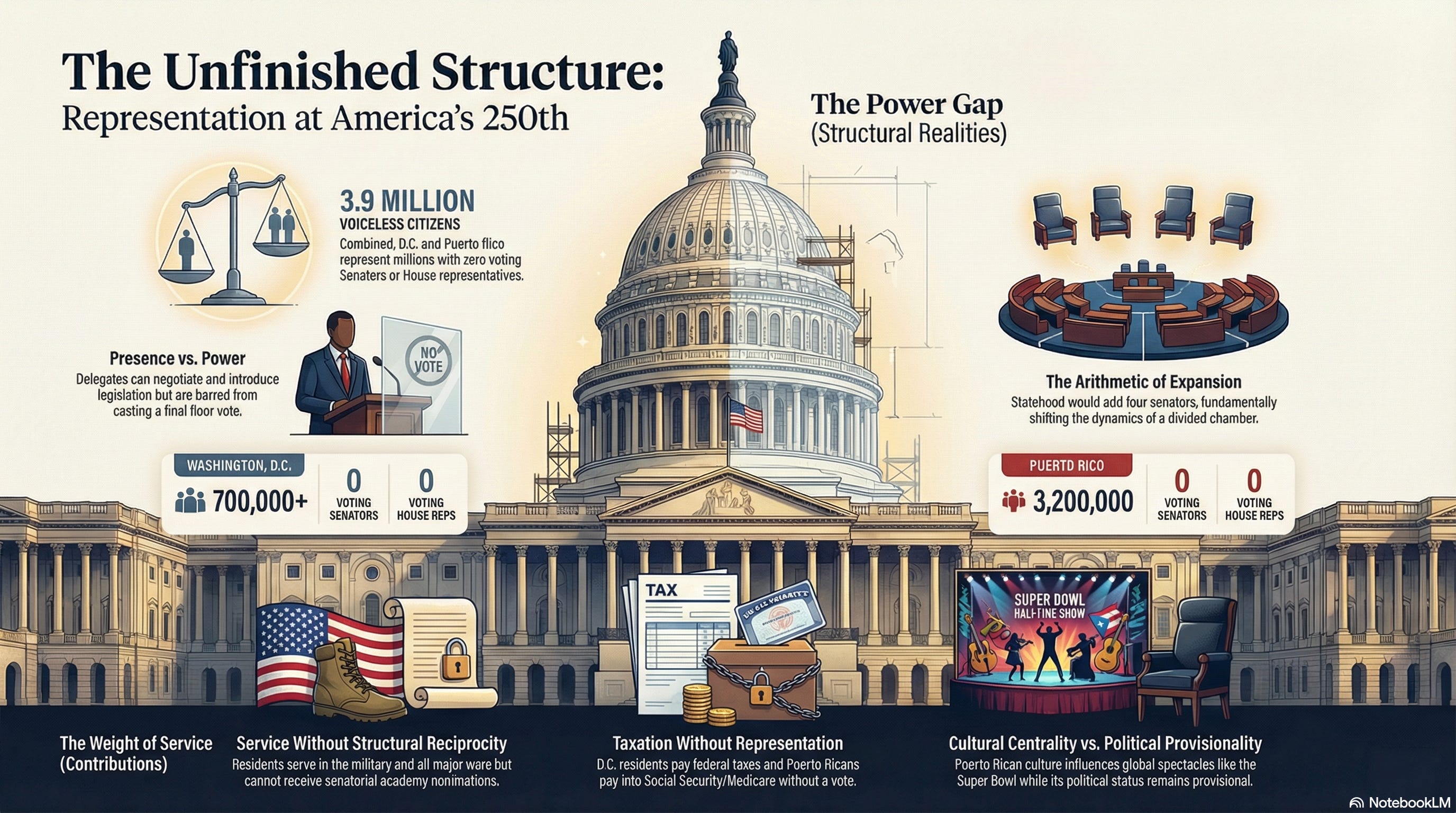
At 250, the United States celebrates its expansion while still governing citizens it has never fully seated.
A republic that reaches its 250th year should recognize its people in its structure.
Yet the United States continues to govern millions of citizens who live under federal law, pay federal taxes, serve in uniform, and shape American culture without full voting power in the nation’s highest decisions.
The contradiction is not abstract.
It has a capital.
It has a territory.
Washington, D.C.
Puerto Rico.
I. The Capital as Laboratory
On April 16, 1862, President Abraham Lincoln signed the District of Columbia Emancipation Act, abolishing slavery in the nation’s capital. More than 3,000 enslaved people were freed. Slaveholders loyal to the Union were compensated. Funds were allocated for voluntary colonization abroad.
Freedom was tested in the capital before emancipation was proclaimed across the Confederacy.
Reform arrived first in the District, but not in full.
Today, more than 700,000 residents of Washington, D.C., live under federal authority without voting senators and without a voting representative in the House.
The capital has long served as a proving ground.
The structure remains unfinished.
II. A Slogan That Relocated
“Taxation Without Representation” helped ignite a revolution. Crispus Attucks became the first casualty of that uprising.
Two and a half centuries later, the license plates in Washington, D.C., still carry that phrase.
D.C. residents:
Pay federal taxes.
Serve in the armed forces.
Are counted in the Census.
Comply with federal law.
They have no voting senators. They have no voting representative in the House.
The grievance did not disappear.
It changed address.
III. A Seat Without a Vote
This year, Eleanor Holmes Norton announced she would not seek re-election as the District’s delegate to Congress. For decades, she introduced legislation, negotiated appropriations, and represented more than 700,000 residents of the nation’s capital.
She has never cast a final vote on the House floor.
The capital’s longest-serving voice in Congress has represented a city that has never been fully represented.
Representation has been present.
Power has not.
IV. Service Without Seating
Washington, D.C., is home to the Pentagon and Arlington National Cemetery. Its residents serve in uniform. They deploy. They return.
Yet because the District has no voting senators, applicants born in Washington, D.C., cannot receive a senatorial nomination to the United States service academies.
In Puerto Rico, residents serve in the same armed forces. They have fought in every major U.S. war of the past century.
Yet Puerto Rico has no voting senators.
Residents of the territory pay into Medicare and Social Security, but there is no voting senator to shape how those programs are strengthened, reformed, or defended.
Service has never guaranteed structural reciprocity.
The pattern is older than this anniversary.
V. Cultural Centrality, Political Provisionally
On February 8, Bad Bunny headlined the Super Bowl halftime show. The league described the performance as global and unifying, part of its effort to expand its Latino and international reach.
Puerto Rico remains a territory of 3.2 million U.S. citizens without voting representation in Congress.
Puerto Rican culture now stands at the center of one of the most-watched American spectacles in the world.
Political authority remains territorially provisional.
The culture travels.
The structure hesitates.
VI. The Arithmetic of Representation
Statehood for Washington, D.C., and Puerto Rico would not only alter who is represented. It would alter the structure of the Senate itself.
Four additional senators would change the arithmetic of a chamber often divided evenly. The dynamics of coalition, confirmation, and legislation would shift accordingly.
Expansion would not be symbolic.
It would be structural.
Resistance to that expansion is often framed as tradition.
Traditions are also structures.
VII. Power and Belonging
America has expanded the circle of belonging slowly.
The enslaved people who built the capital could not vote in it.
Women who sustained the republic could not elect its leaders.
Veterans who returned from World War II did not receive equal access to federal benefits.
Expansion has rarely arrived without hesitation.
At 250, the hesitation remains visible.
VIII. The Structure at 250
In the capital where slavery was abolished by federal act:
Taxes are paid.
Service is rendered.
Federal authority is exercised.
There are no voting senators.
There is no final vote in the House.
There is no senatorial nomination to the nation’s service academies.
In the territory whose residents serve in uniform and contribute to federal programs:
Citizenship is conferred.
Military service is given.
Cultural influence is exported.
There are no voting senators.
There is no voting representation in Congress.
The revolution’s slogan circulates on license plates.
The Senate debates expansion while governing those it has not fully seated.
The nation commemorates 250 years of growth.
The creed has expanded.
The seating has not.
At 250, the question is not whether these citizens belong.
It is why the structure still hesitates.
The ledger remains open.
Honestly they should prioritize them as the equal citizens. 😭 Why that country always has problems with other races ? 🤯 I mean like really, they go everywhere around the globe to colonize the lands that do not belong to them , and they fail to accommodate the citizens that belong in their country. How can they celebrate 250. Pretty ironic. I mean like postcolonial literature is full of this. I read so many novels in African literature about this. I pray they learn to understand all this. Thank you for sharing this amazing piece. Life would be so easy if they could understand ALL human beings are equal ! And America as world's superpower should consider this.