

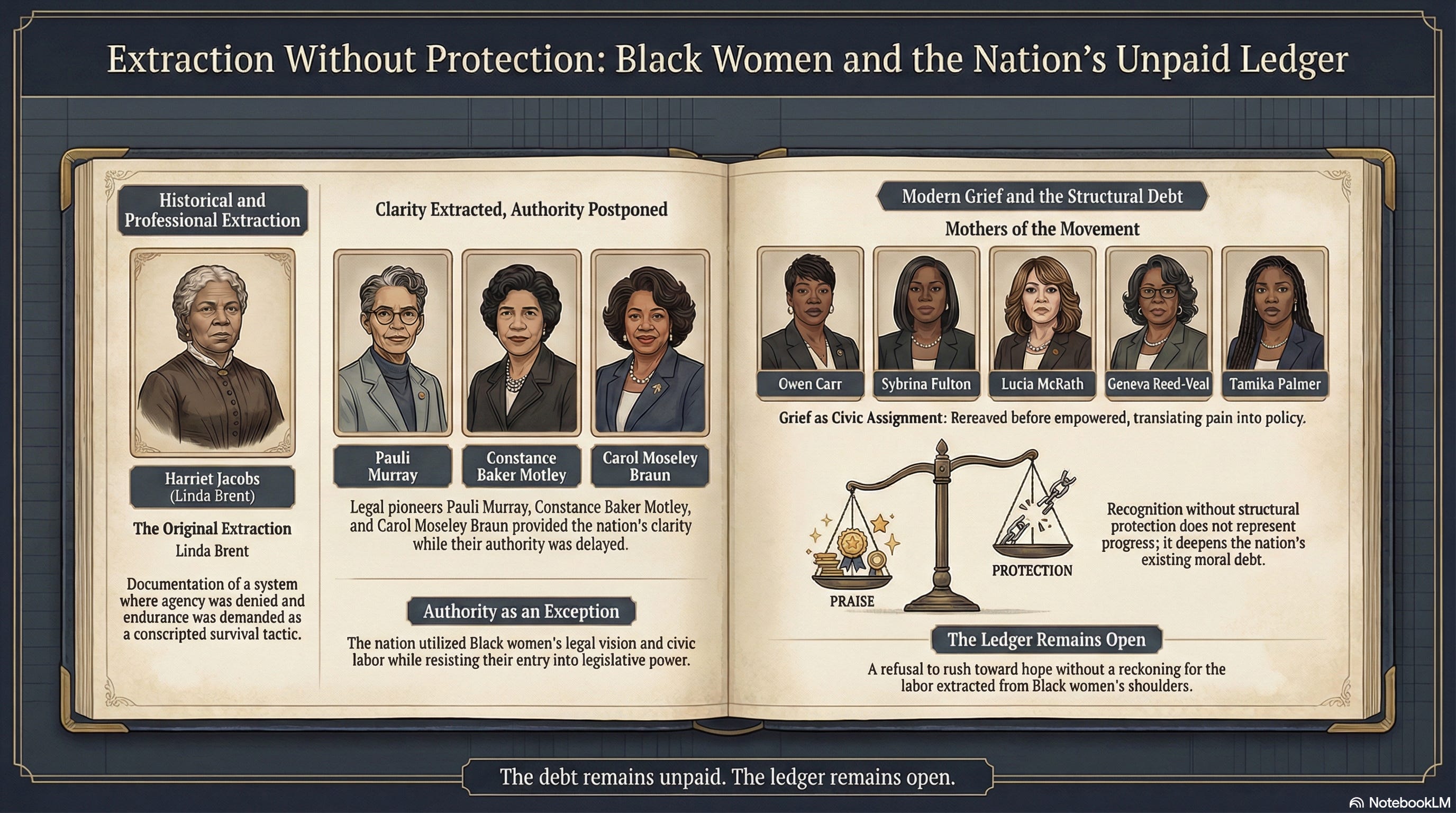
The nation has learned how to praise Black women without listening to what their presence indicts.
It has learned how to celebrate strength without accounting for what that strength has been required to carry. It has learned how to name progress while avoiding the cost of delay.
This is not an essay of appreciation.
It is an entry in the ledger.
As Women’s History Month begins, it arrives inside a longer reckoning. At 250 years old, the nation is being asked to examine not only what it has built, but who has been required to hold it together without cover.
From the beginning, Black women have been asked to carry what the nation refused to carry itself.
The Original Extraction
The ledger begins with Harriet Jacobs. Writing as Linda Brent, she did not narrate heroism; she documented the theft of her own agency.
In Incidents in the Life of a Slave Girl, she described a young girl forced into impossible moral calculations by a system that denied her agency, dignity, and protection, then judged her for surviving the terms it imposed. Faith was distorted into discipline. Motherhood was weaponized as leverage. Endurance was recast as virtue.
Her story is often taught as history.
It is more accurately understood as a pattern.
Linda Brent did not consent to leadership. She was conscripted into survival. The nation extracted her body, her labor, her morality, and then demanded gratitude for her endurance.
Extraction without protection was not an accident of slavery.
It was a design feature.
Authority Delayed, Clarity Used
That design did not end with emancipation. It evolved.
Pauli Murray could see the Constitution more clearly than many of the men entrusted with interpreting it. Her legal reasoning shaped the arguments behind Brown v. Board of Education, yet her authorship was sidelined.
Her clarity was welcomed as a resource, not as an authority.
Constance Baker Motley argued and won cases that dismantled segregation across the South. Only afterward did she have to fight to sit on the very bench she helped make possible. Her leadership was treated as an exception, not a correction.
Carol Moseley Braun entered the United States Senate in 1993, two centuries after its founding. She did not arrive early. She arrived late, into an institution that had long benefited from Black women’s civic labor while denying them legislative power.
These are not isolated achievements.
They are ledger entries.
The nation repeatedly drew from Black women’s vision while postponing their authority. Clarity was extracted. Protection was withheld.
Grief as Civic Assignment
That burden has not remained theoretical.
In our own time, the Mothers of the Movement were not formed by ambition or ideology. They were formed by loss.
Gwen Carr.
Sybrina Fulton.
Lucia McBath.
Geneva Reed-Veal.
Tamika Palmer.
Mothers whose children were taken by state violence or gunfire, then asked to translate grief into reform, pain into policy, mourning into movement.
They were not empowered first.
They were bereaved first.
This nation did not protect their children.
Then it turned to them to redeem the failure.
Grief became civic labor.
Pain became platform.
Justice remained deferred.
This is not resilience.
It is reassignment.
Progress, Named Too Late
Even now, as political gains are rightly noted, the accounting remains incomplete.
In Albany, New York, the election of Black women to senior leadership has been named as progress. And it is. And it is also late. It arrives after generations of unpaid labor, after decades of organizing, stabilizing, and sustaining institutions that did not yet make room for them.
Representation matters.
But representation after prolonged exclusion is not generosity.
It is correction, delayed.
To name these moments only as milestones is to miss their meaning. They are not proof that the system works. They are evidence of how long it resisted the truths Black women have carried all along.
What the Nation Still Refuses to Carry
The nation still asks Black women to do what it refuses to do itself:
To tell the truth without protection.
To lead without permission.
To forgive without repair.
To believe without evidence that belief will be honored.
This is not destiny.
It is by design.
And praise, without accounting, only deepens the debt.
The Ledger Remains Open
The Unpaid Ledger exists because some debts do not appear on balance sheets. They surface elsewhere. In bodies. In delayed authority. In grief converted into governance. In leadership extracted instead of shared.
This is not a call to despair.
But it is a refusal to rush toward hope without reckoning.
A nation that tells the truth can be trusted with the future.
A nation that avoids it will keep assigning the cost to the same shoulders.
Black women have carried the conscience of this country for generations.
Not because they were appointed to it.
But because the nation kept failing to carry it itself.
Until that burden is fully named, the ledger remains open.
And the debt remains unpaid.