

Black History Month did not begin as a consolation prize.
It began as an act of defiance.
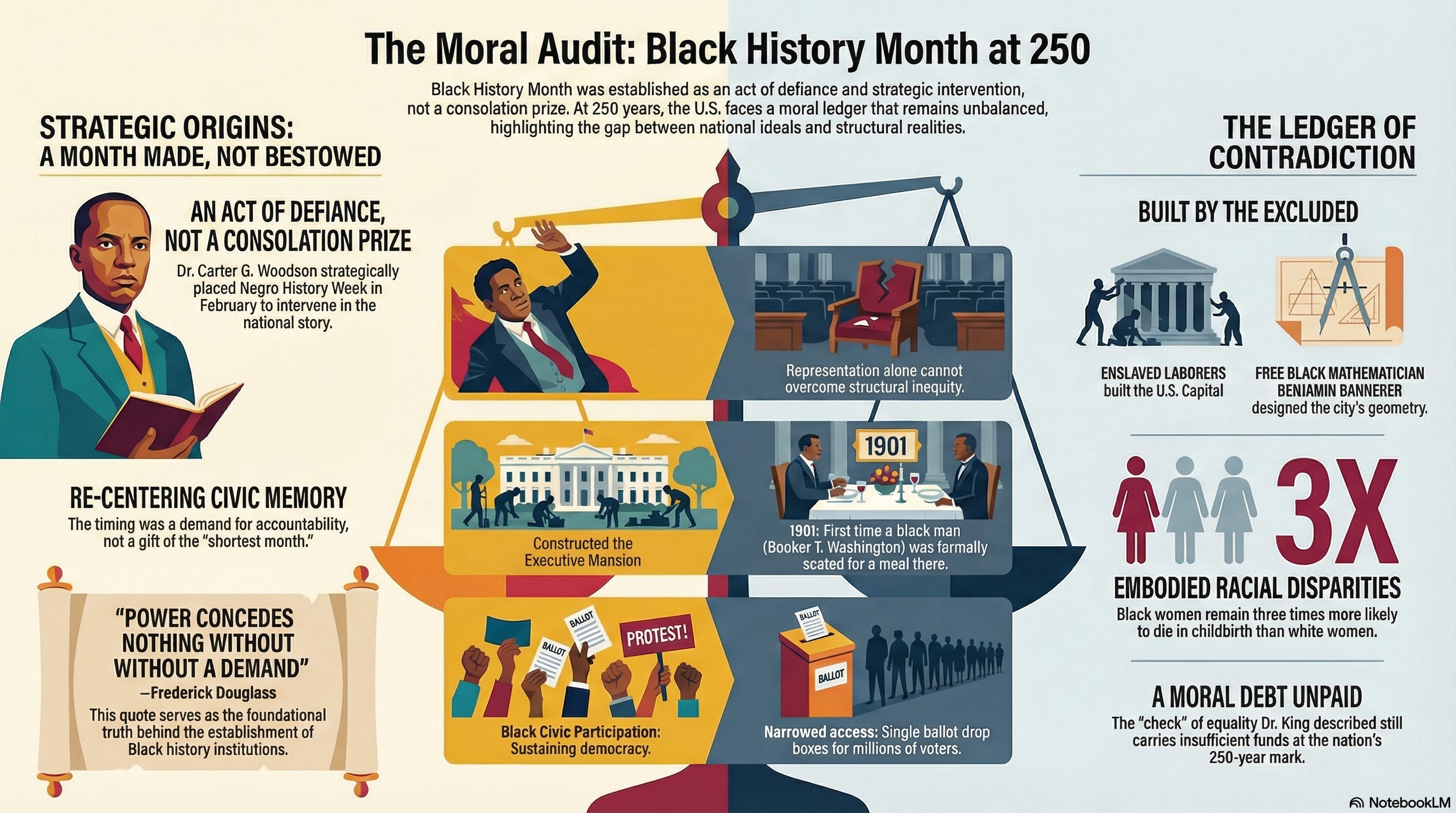
Seven years after the NAACP formally adopted Lift Every Voice and Sing, Dr. Carter G. Woodson would establish Negro History Week, giving institutional shape to a memory Black communities were already carrying.
In February 1926, Woodson placed it deliberately between the birthdays of Abraham Lincoln and Frederick Douglass. That choice was not sentimental. It was strategic. It was an intervention in a national story that refused to tell the truth about itself.
Frederick Douglass reminded this nation long ago that power concedes nothing without a demand. It never has, and it never will. Black history in America has been shaped by that truth. As with so much else, we took what existed and transformed it, not out of abundance, but out of brilliance under constraint. Our history is turning scraps into sustenance, discarded cuts into delicacies, and ten cents into a dollar.
That discipline did not make us smaller.
It made us exact.
In this country’s 250th year, Black History Month is not a commemoration.
It is an audit.
And the balance sheet is still in the red.
The books remain unbalanced.
A Month Made, Not Bestowed
The familiar refrain that Black people were “given the shortest month of the year” mistakes intent for insult. Negro History Week was never about duration. It was about placement. It was about re-centering African American history within the nation’s civic memory.
February is not insufficient.
It is dense.
It holds the birth of Bishop Richard Allen, a formerly enslaved man who founded the African Methodist Episcopal Church after being pulled from his knees while praying in a segregated gallery. The A.M.E. Church was not born of preference. It was born as a repudiation. Through structure and worship, it declared that dignity would not be negotiated and faith would not be policed.
February is also Heart Health Awareness Month, a reminder that America’s racial disparities are not abstract. They are embodied. Black communities continue to bear disproportionate burdens of cardiovascular disease. Black women remain three times more likely to die in childbirth than white women, a disparity unchanged since Reconstruction.
The people who built this nation continue to pay for it with their bodies.
February also contains Presidents’ Day, honoring a political lineage that has never included a woman president and in which no Black woman has ever been elected governor. Barack Obama’s presidency marked a breakthrough. It also exposed a harder truth: representation alone cannot overcome structural inequity.
If February is short, it is not shallow.
It is dense with truth, history, and contradiction.
A Nation Still Avoiding Its Origin Story
America has learned how to tell its founding story as unity and principle. We have learned how to smooth its edges, how to celebrate ideals while sidestepping cost.
But the record tells something else.
The first person to die in the Boston Massacre, the event that lit the fuse of the Revolution, was Crispus Attucks, a Black man of African and Indigenous descent. His death stands as one of the earliest receipts of Black sacrifice in a nation slow to honor it.
The capital built to house the new republic was constructed by enslaved laborers. The man who helped survey and design it, Benjamin Banneker, was a free Black mathematician whose intellect shaped the very geometry of the city.
And when President Theodore Roosevelt invited Booker T. Washington to dine at the Executive Mansion, the backlash was so fierce that more than three decades passed before another Black man would formally share a meal there with a sitting president, and the building itself would soon be renamed.
A building built by enslaved people waited until 1901 to seat a Black man of national stature at its table.
How that building must have shifted more than a century later under the footfall of Sasha and Malia Obama, two Black girls growing up on ground that had excluded their ancestors.
The republic’s architecture has always carried this tension.
Liberty proclaimed. Exclusion enforced.
From MLK Day to Black History Month
The corridor from mid-January through February forms a forty-five-day immersion in Black history, if the nation is willing to see it.
Rev. Dr. Martin Luther King Jr. Day did not emerge from benevolence. It was secured through the persistent labor of Coretta Scott King and a cultural campaign that reached its crescendo in Stevie Wonder’s protest anthem “Happy Birthday,” a song many now sing without remembering it was written as a demand.
Even King’s legacy has been managed. His dream is routinely invoked to oppose affirmative action rather than to confront economic injustice. His critique of capitalism has been largely erased. His insistence on voting rights is now countered by leaders who speak of election integrity while narrowing access, providing a single ballot drop box for millions of voters in Harris County, Texas, and calling that stewardship.
The methods have changed.
The intent has not.
The New Culture War
If the early twentieth century relied on Birth of a Nation to manufacture fear, the twenty-first relies on phrases like “critical race theory” and “wokeism.”
To frighten voters.
To justify book bans.
To gut African American studies.
The message is unchanged. If the story cannot be controlled, the storytellers must be.
Black History Month endures because it is a counter-memory. Because it insists that a nation cannot be free while it is still lying to itself.
America at 250
At 250 years old, the United States carries a ledger crowded with contradiction:
a revolution sparked by a Black man’s death
a capital built by enslaved labor
a democracy sustained by Black civic participation
a constitution repeatedly amended to include those it first excluded
a republic still hesitant to tell the full truth about itself
This nation remains in debt. Not financially. Morally. Not to foreign powers, but to the people who made its existence possible.
Dr. King said America had written a check marked insufficient funds.
At 250, the check has still not cleared.
The ledger is still open.
The Hope Worth Carrying
There is hope, but it is not sentimental.
It is rooted in reckoning.
A nation that tells the truth can be trusted with the future.
A nation that refuses it will keep repeating the bill.
Black History Month is not America’s shortest month.
It is its sharpest mirror.
And at 250, the reflection is clear.
Until the debt is paid,
the promise remains unfinished
.
Amazing article ! I love February and I love black Americans. 🌷💗🌹💕🎀🫶🏻 The way you wrote about it tells me a lot about the history. And also, the way America has treated the blacks. I mean that's really sad how they treat them 😭 and yes, it's the black women has suffered a lot. I know a case from history there was a doctor (a gynecologist) who used to perform surgeries on a black woman. There is painting of it . How brute ! And he did those surgeries without any anesthesia because that brute believed black women can ensure pain 😭😭😭 Mt heart cried badly when I saw that post on Instagram. And what's even worse ? That stupid idiot violent brute is remembered as the pioneer of gynecology and the world has forgotten the woman who was the victim of his abuse. I'm deeply sad and so frustrated. These women deserve more recognition and rights. That's why I work hard and want to one day help all the women and children who've been suffering so much. 😭🫶🏻🎀 Your articles make me understand how history is shaped and you're true America should be ashamed for the worst treatment they gave to black Americans. May God protect them. Thanks for writing this piece. I needed to hear this.