

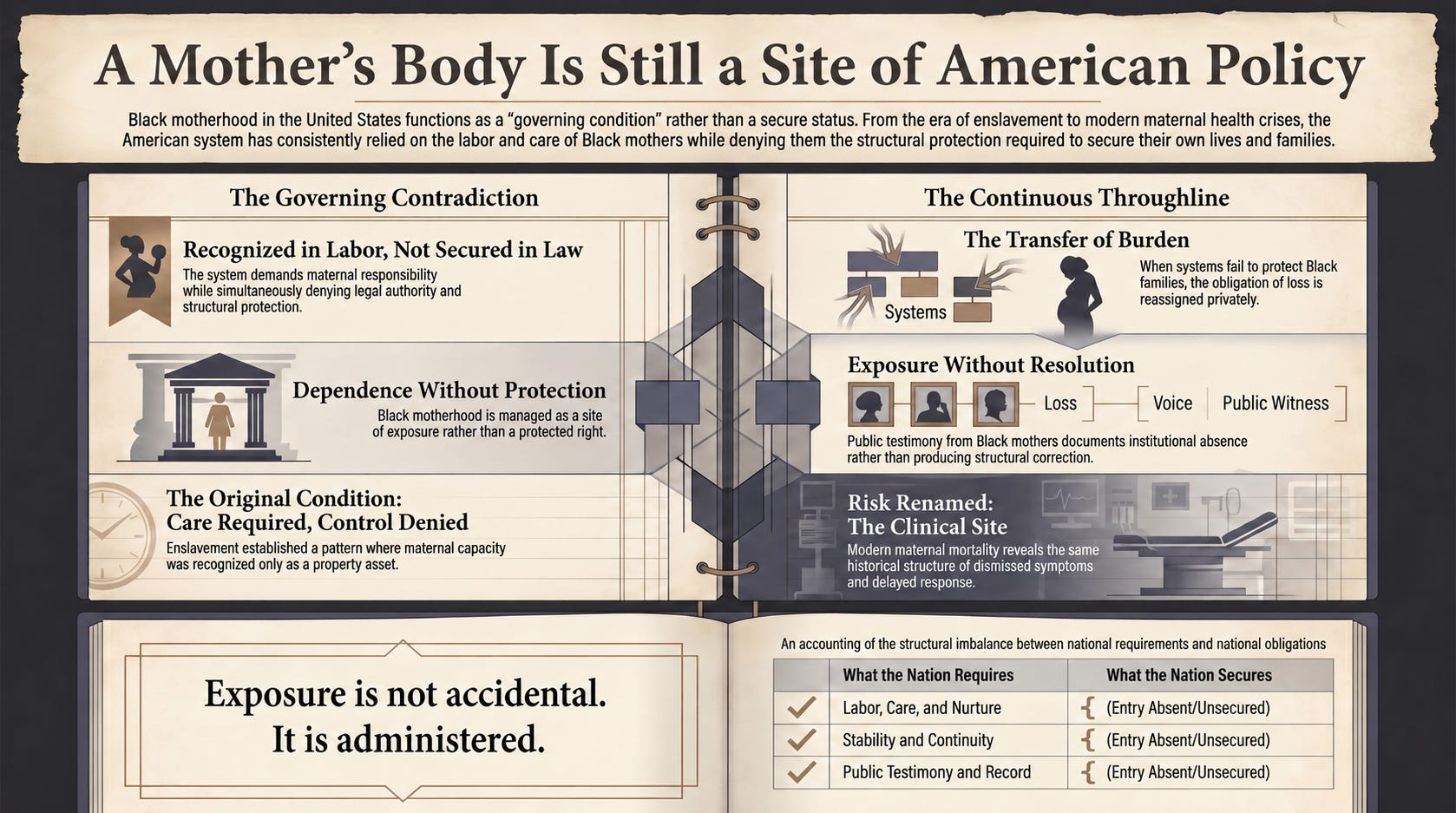
America treats Black maternal mortality as a failure of medicine. It is not.
It is a failure of protection.
Black motherhood has never been a secure status in this republic; it has been a condition managed under consistent exposure. The setting changes—from the plantation to the delivery room.
And the exposure remains.
I. Authority Without Protection
The condition begins with a contradiction.
Under slavery, Black women bore children who were legally property.
Motherhood existed.
Protection did not.
A mother could be held responsible for a child she did not have the legal authority over.
Care was required.
Control was denied.
As Harriet Jacobs makes clear in Incidents in the Life of a Slave Girl, even a mother’s most intimate decisions unfolded within a system that recognized her capacity to bear life but not her right to secure it.
Her children, like all those born into slavery, were treated as property—assets that increased the value of the enslaver.
Fertility raised a woman’s price.
It did not secure her family.
Black motherhood was recognized in labor.
It was not secured in law.
II. Risk Without Consequence
When legal status changed, the condition adjusted.
The exposure did not.
In the era of lynching, Black mothers carried children who could be taken without consequence.
When Mamie Till-Mobley insisted that her bludgeoned son, Emmett Till, be seen in an open casket, she did not introduce the nation to violence.
She forced recognition of what the system permitted.
Ida B. Wells did not uncover isolated acts.
She documented what enforcement did not interrupt.
The risk was visible.
The protection was not.
Loss could occur.
The system did not have to answer for it.
III. Loss Without Relief
The condition extended beyond the act.
Protection was not only uncertain.
It was frequently absent.
Black mothers were required to continue after it failed.
Husbands lynched.
Sons murdered.
Households destabilized.
Obligation did not pause.
It transferred.
The system did not absorb the loss it allowed.
It reassigned it.
IV. Testimony Without Guarantee
True to American tradition, Black motherhood is often called to the witness stand not to inform policy, but to perform it. When protection is not provided, explanation is required. The state does not offer security; it offers a microphone.
Mary McLeod Bethune and others did not appear before Congress to argue preference.
They appeared to document absence.
Their testimony did not establish new conditions.
It recorded what had not been secured.
The appeal was moral because protection was not guaranteed.
The pattern held:
when the state did not secure Black life,
it required Black women to account for that failure.
V. Exposure Without Resolution
That requirement did not end.
It changed form.
Sybrina Fulton became the voice her son, Trayvon Martin, could no longer carry.
Gwen Carr spoke when her son, Eric Garner, called out “mama” and was not answered.
Their presence is not exceptional.
It is consistent.
They did not enter public life by design.
They were placed there by loss.
When Black children are not protected,
their mothers become the public record.
Exposure produces recognition.
It does not produce correction.
VI. Risk Renamed
The setting has shifted.
The condition has not.
Consider Andrea Thurman, the 28-year-old Georgia mother who died in 2024 after she couldn’t access legal abortion care.
Black women experience disproportionately high rates of maternal mortality in the United States.
This persists across income and education.
The mechanisms are documented:
delayed treatment
dismissed symptoms
unequal care
The site is clinical.
The structure is familiar.
The death of Thurman did not introduce this condition.
It revealed, again, how delay, fragmentation, and non-response can converge at the point where protection is most required.
The system does not require intent to produce this result.
It produces it consistently.
The Throughline
Across each condition:
authority without protection
risk without consequence
loss without relief
testimony without guarantee
exposure without resolution
risk renamed
the same structure holds.
Black motherhood operates under conditions the nation has not made binding.
This is not episodic.
It is continuous.
The Accounting
The nation has relied on Black motherhood in every era:
to labor
to nurture
to stabilize households
to sustain communities
It has not constructed a system that reliably protects Black mothers themselves.
This is not a gap.
It is a governing condition.
The Question after Mother’s Day
The day after Mother’s Day, the nation still speaks the language of care.
It has not established the discipline of it.
Strength is praised.
The requirement of that strength remains unexamined.
The holiday functions as ritual.
It allows the substitution of a flower for a floor—
a gesture in place of structure.
If the nation truly valued Black motherhood,
it would not require heroism in the clinic.
It would ensure recognition within it.
The question at 250 is not whether the nation can be moved by her story.
It is whether it will be governed by her right to survive it.
Concisely stated:
Can a republic call itself a democracy while treating the bodies of its most reliable citizens as sites of managed risk rather than protected life?
The Ledger
The record is established.
The testimony has been given.
The outcomes are consistent.
The question is no longer whether this condition exists.
The question is whether the protection of Black motherhood will be treated as a binding obligation
or continue to be managed as exposure.
The ledger remains open.
Thank you for bringing attention to something that continues to be overlooked. The US seems to be on a fast track backwards in history and it is terrifying.
This is equally brilliant and brutal—concisely illuminating a systemic and moral failing while honoring and testifying for these women.