

When my father showed us the back porch he built in Holly Springs, he didn’t call it an expansion, he called it survival. Ten people under one roof, space stretched to its limits, every inch a testament to growth that could not be ignored. America’s political house has not learned that lesson.
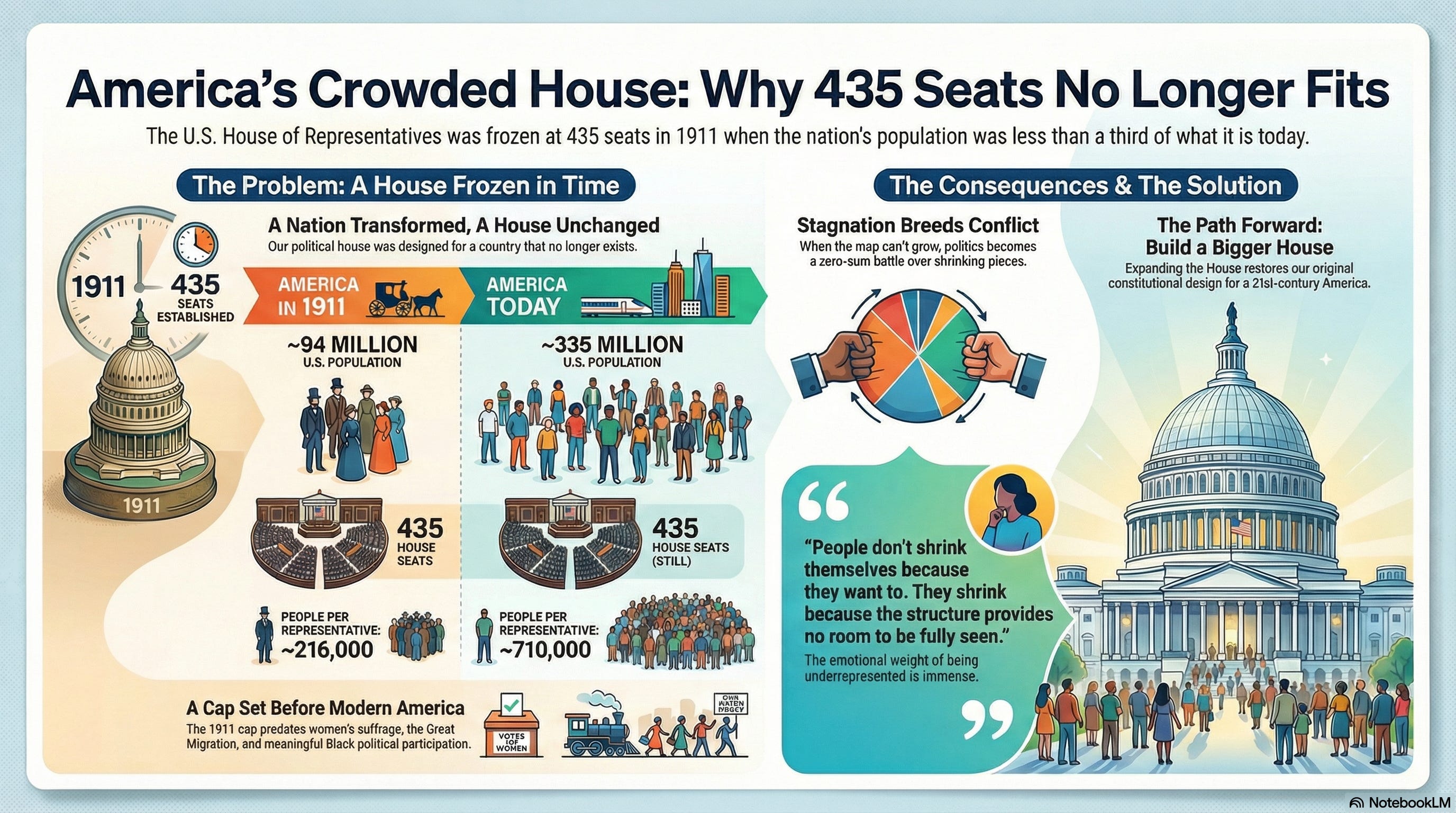
The U.S. House of Representatives has been capped at 435 seats since 1911. Before the Great Migration, before women’s suffrage, before meaningful Black political participation, before modern immigration, before America became the multiracial democracy it now claims to be.
I. The House We Inherited — and the Homes That Formed Us
I come from a people who understood that space must expand when life expands.
Every summer, when our family drove from Ann Arbor back to Mississippi, my father would take us to the house in Holly Springs where he grew up: a place built by hands, sweat, and necessity. He showed us the back porch he and his brothers constructed, a modest 200-square-foot addition that made room for a growing family. By the time it was built, there were ten people living in that home. The “expansion” wasn’t luxury. It was survival.
Inside, he pointed to the space where he and his brothers slept on pallets because the only bed belonged to his two sisters. And every visit, he reminded us of the #10 wash tub, how each child bathed one after another, praying not to be the last in line.
Those memories taught me something long before I learned the word “representation”:
When the structure stays the same while the people multiply, suffering becomes inherited.
America’s political house has been doing this to us for more than a century.
II. A House Built for 94 Million Is Now Asked to Hold 335 Million
In 1911, Congress froze the House at 435 seats. That moment in history was defined by:
women without suffrage
Black Americans locked out by Jim Crow
Chinese exclusion as law
Indigenous children forced into assimilation schools
a population one-third of today’s
Yet our political house — designed to grow as the nation grew — has not expanded once since. The Constitution explicitly permits expansion of the House, and the framers expected its size to grow alongside the nation’s population.
America changed. Black America moved, built, and transformed the nation. But the House stayed small, rigid, and frozen in time. A democracy cannot keep the same square footage when three additional floors of people have moved in.
III. When the People Shift and the House Refuses to Move
Black America knows what it means to outgrow structures that refuse to expand.
My grandmother’s house in Holly Springs taught that lesson. Ann Arbor taught another. As a high-school student, I sat in school board meetings arguing for a teacher contract “worthy of the paper it was written on” during a district strike. I watched adults debate whether the people shaping our future deserved fair compensation. Even then, I understood what happens when systems don’t grow with the people inside them.
I later helped organizations expand into new states, advised national climate-tech ecosystems, and facilitated community conversations — including “Do Black Lives Really Matter?” — long before a hashtag became a movement.
What I learned in all those spaces is simple: When structures don’t expand, polarization takes over. When representation stagnates, communities suffer.
Mid-census redistricting in places like Texas and California happens because the House is too small to absorb demographic reality. When the map can’t grow, politicians fight over shrinking pieces of it, turning representation into a zero-sum battle where someone must lose for someone to win. Critics argue that expansion would create inefficiency or chaos, but the chaos already exists when representation is rationed.
The Great Migration reshaped cities across the country — Chicago, Detroit, Los Angeles, the DMV, Oakland — as six million Black people moved seeking dignity, wages, and air. America shifted dramatically. The House added zero seats.
We have always been the people who arrive before the map catches up. The frozen House is another version of that story.
IV. The Emotional Weight of Being Underrepresented
Representation is not math. It is emotional architecture. One representative now carries 710,000 people — more than any democracy with our population has ever attempted. No human being can hold:
the grief of ten neighborhoods,
the needs of a million families,
the dreams of thousands of children,
and the inequities of a rapidly diversifying nation
while sitting in a seat designed in 1911. This is what it means to be underrepresented: People don’t shrink themselves because they want to. They shrink because the structure provides no room to be fully seen.
V. The Real Question at 250
A Semi-quincentennial is not a celebration. It is an audit.
We must ask: How can America honor 250 years of democracy inside a political house too small for the people who built it?
My father picked 400 pounds of cotton — four times the expectation — as a child. My mother taught generations of public-school students in Ann Arbor. Black America has carried this country further than its founders ever imagined — through labor, brilliance, innovation, civic leadership, cultural creation, moral courage, and democratic sacrifice. If the nation wants to honor that inheritance, it must expand the structure that reflects it.
VI. The House We Need
A functioning multiracial democracy cannot operate inside a monocultural architecture. Expanding the House is not radical. It is restoring the original constitutional design. A House built for 1911 cannot hold a 2026 America.
This is the work before us:
grow the House
shrink the distortion
expand representation
reduce zero-sum politics
build a democracy worthy of the people who live in it
A house built for the past cannot hold the promise of our future. If America is to honor 250 years of democracy, it must finally expand its walls, making room for every voice, every story, and every dream that has too long been crowded out. The work begins not by asking who belongs, but by building a home worthy of all who are already here. Only then can we call ourselves a nation truly seen.
No family celebrates a milestone in a home too small to hold them. America shouldn’t either.
I had never thought of this before.
Brilliant !!! This article opened my eyes to truth ! 🌹💕🎀🫶🏻🤯 You do not shy away from staying the truth and that's the attribute I admire about your writing style. I needed this. Thank you for writing this awesomeness.