

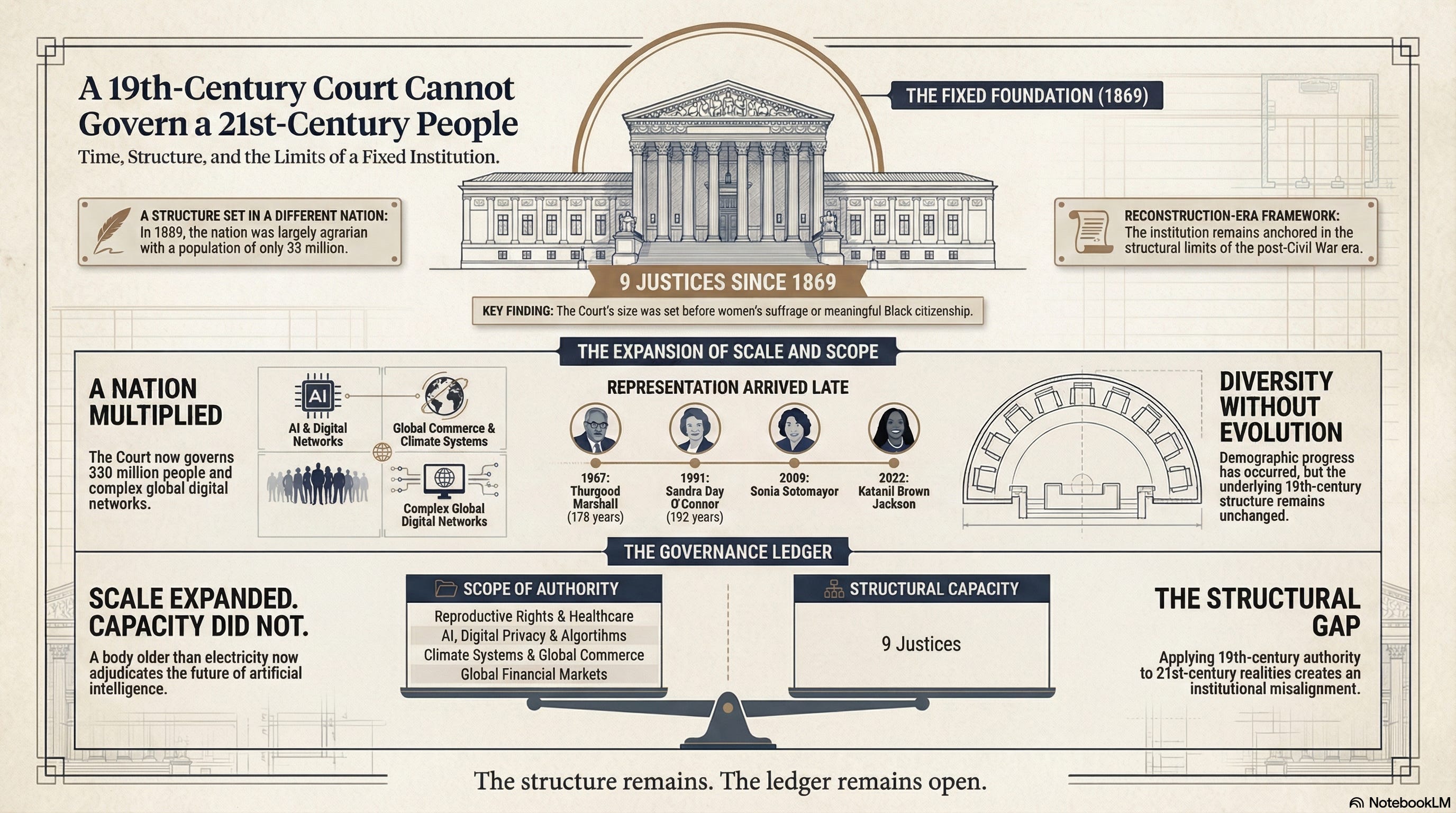
The Supreme Court has remained fixed at nine justices since 1869: before women could vote; before Black Americans held meaningful citizenship; before digital life existed; before the United States became a multiracial democracy.
The nation has changed.
The Court has not.
I. I Was Raised in a Community Where Leadership Evolved, Not Frozen in Time
Ann Arbor, Michigan, shaped my understanding of what strong institutions look like. In my Black church, leadership was not a concept; it was a community:
• the superintendent of schools
• school board members
• police officers
• U of M professors
• civic and business leaders
• Divine Nine members and Jack & Jill families
Black excellence was not exceptional; it was the ecosystem.
From that environment, I learned a foundational truth: healthy institutions grow with the people they serve; unhealthy institutions remain fixed and expect the people to shrink to fit their limits.
The Supreme Court, unchanged in size since 1869, reflects the latter.
II. Leadership Must Expand With Responsibility
When I was elected President of my Huron High School class, I did not win because of campaign signs; I did not have any. Leadership had been cultivated in me by a community that believed excellence was our inheritance.
Soon after, I was asked to speak at Crisler Arena: a full stadium. There, I learned that leadership must scale with the size of its audience.
That lesson reveals the Court’s imbalance: a nation of 330 million people is governed by a Court built for 38 million. Scale without growth is not stability; it is strain extended over time.
III. Outdated Institutions Produce Modern Harms, Especially for Black America
The Supreme Court now governs:
• reproductive freedom
• voting rights
• policing and criminal justice
• education access
• environmental survival
• healthcare equity
• LGBTQ+ rights
• immigration and citizenship
• digital privacy, AI, and surveillance
Yet a Court older than electricity decides the future of algorithms. A Court older than the NAACP adjudicates modern civil rights. A Court older than many American universities determines the fate of higher education.
When outdated institutions make contemporary decisions, the burden does not distribute evenly. Black communities absorb the consequences first and most consistently.
Applying 19th-century authority to 21st-century realities produces a pattern; the outcome is neither surprising nor new.
IV. The Court’s Representation Timeline Reveals Its Deeper Pattern
Representation is structural, not ornamental. The Court’s demographic history tells a longer story:
• 178 years to seat the first Black justice: Thurgood Marshall, 1967
• 192 years to seat the first woman: Sandra Day O’Connor, 1981
• 220 years to seat the first Hispanic justice: Sonia Sotomayor, 2009
• 233 years to seat the first Black woman: Ketanji Brown Jackson, 2022
These milestones matter. They also reveal a pattern: a Court that required more than two centuries to reflect the nation did not arrive at completion; it arrived at delay.
Diversity within a fixed structure does not resolve the structure. Representation, without corresponding institutional evolution, remains incomplete.
V. Representation Is Not Just Symbolic; It Is Structural
The composition of the Court is inseparable from the structure that produces it.
A Senate that governs without full representation shapes confirmations without full legitimacy. A confirmation process constrained by narrow margins produces outcomes that reflect those constraints.
When the structure is partial, the authority it generates carries that partiality forward.
A Court formed through that process does not stand outside the structure; it extends it.
And it matters who is absent. Communities historically denied full political voice do not simply lack representation; their realities remain under-interpreted.
A Court missing those perspectives is not neutral. It is incomplete.
VI. A Court Built for Reconstruction Confronts a Different Nation
When the Court was last set at its current size:
• women had no suffrage
• Black citizenship existed largely in theory
• the United States had 37 states
• the population was 38 million
• modern medicine had not taken hold
• radio was not yet common
• the nation was agrarian, not digital
That structure now interprets:
• artificial intelligence and intellectual property
• environmental regulation and climate migration
• data privacy and surveillance
• global commerce
• reproductive autonomy
• policing and racial justice
The distance between those two realities is not abstract. It is structural.
VII. Formation and Recognition
Ann Arbor showed me that institutions must evolve. Crisler Arena showed me that leadership must scale. My high school presidency showed me that readiness does not require spectacle.
These experiences point to a consistent truth: the people change; the country changes; institutions that do not adjust begin to misalign with the reality they are meant to govern.
The highest court in the land is not exempt from that pattern.
VIII. The Structure at 250
At 250 years:
The Court remains fixed in size.
The nation it governs has multiplied in scale, complexity, and composition.
Its decisions shape domains that did not exist when its structure was last adjusted.
Its authority extends across populations historically excluded from its formation.
Its composition reflects progress.
Its structure reflects continuity.
The gap between those two realities is not symbolic.
It is functional.
IX. The Questions at 250
Can a 19th-century Court govern a 21st-century people?
Can a structure designed before Black political power interpret its present?
Can a body formed before women’s citizenship define the boundaries of their autonomy?
Can a Court shaped before digital life regulate digital existence?
The questions are not new.
The conditions are not temporary.
The structure remains.
The ledger remains open.